Nov 24, 2026
1 in 5 students starting upper secondary school has significant gaps in mathematics
Our 2024 study of 1,500 students across Finland: 49 % start upper secondary school with minor gaps in mathematics and 22 % with significant gaps.
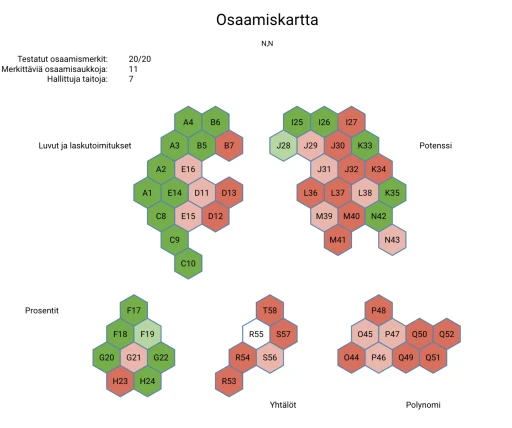
In mathematics, everything builds on what has been learned before. A student who never quite mastered fractions or equations in lower secondary school carries that gap into every new course. To find out how common these gaps are, we studied the mathematics skills of 1,500 students starting upper secondary school at schools across Finland in 2024.
The key findings
- 49 % of the students had minor gaps in their mathematics skills.
- 22 %, more than one in five, had significant gaps.
- Only about three in ten started upper secondary school without notable gaps.
Why it matters
Gaps in the basics make it harder to take in new topics and to deepen understanding, and in a class of 30 they are hard to see from the front of the room. The same course can be too easy for some students and out of reach for others, while the teacher rarely has time to find out who needs what.
The gaps don't close over the summer
In a 2022–2025 project with Närpes and Korsholm upper secondary schools, the same students were assessed in the spring of 9th grade and again at the start of upper secondary school. Their skill levels were almost unchanged. A gap that exists at the end of lower secondary school is still there in the first upper secondary course, which also means that a spring assessment already gives reliable information for the transition. Read more about the project.
What schools can do
- Assess at the start of the school year. A skills assessment shows each student's level by content area, for the individual and for the whole group.
- Show students their own map. A personal skills map shows what they already master and what to review before moving on.
- Target the review. Review material and the AI tutor Gemma let students practise exactly the skills they are missing, on their own level.
- Follow up during the year. Course-specific assessments (for example MAG1, MAB2 and MAA2) keep the picture up to date, so support can start as soon as a need appears.
About the study
The study was based on a sample of 1,500 students from upper secondary schools across Finland who took eMathStudio's skills assessment in 2024.
Read more about the skills assessment or book a demo to see how it works at your school.